As part of our continued efforts to uphold the best in class industry standards, Omnicom Media Group UK is delighted to hold the IAB Gold Standard 1.0 and is in the process of re-certifying for the IAB Gold Standard 1.1.
As an organisation, Omnicom Media Group UK is a great supporter of all the work the IAB does driving even greater industry standards.
IAB Gold Standard
The Gold Standard initiative is an important framework to define a more robust digital ecosystem, giving clients, publishers, technologies and buyers increased reassurance and certainty throughout the digital media buying process. Our partnership with the IAB forms a key foundation within our digital best practice approach, which delivers market leading solutions for clients.
We are excited to partner with the IAB to continue to develop the Gold Standard in 2020 and beyond.
Omnicom Media Group UK supports Coalition for Better Ads
Omnicom Media Group UK supports the Coalition for Better Ads in its mission to improve the online advertising experience for consumers and promote adoption of the Better Ads Standards. As a result, the lowest ranking ad experiences are not compliant in our creative strategy.
Omnicom Media Group UK supports the IAB Initiative Ads.txt
Omnicom Media Group UK supports the IAB initiative ads.txt (also known as Authorized Digital Sellers). Where an ads.txt file is present, Omnicom Media Group UK requires that only publisher inventory from authorized sellers is purchased. In the absence of an ads.txt file Omnicom Media Group UK is actively working with publishers to implement ads.txt on their sites to ensure they support the Gold Standard Initiative.
Every year there is more and more hype around Black Friday and Cyber Monday. Consumers are now planning the basis of their festive period shopping around discounts promoted online by the major retailers such as Amazon, John Lewis, Argos and Game to name a few. However, while some retailers focus on driving sales around Black Friday, many do not have a wider ecommerce strategy in place to drive repeat business across the entire year and increase revenues.
There is a vast spectrum of arguments surrounding the origins of the term ‘Black Friday’. Indeed, in the UK for many years it was synonymous with the busiest day of the year for the emergency services. However, fast forward to the present day and it can be associated with one thing and one thing alone – the most important retail day of the calendar year. It can be a make or break time for store owners the length and breadth of the country.
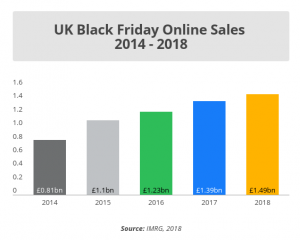
The UK’s online shoppers spent £1.49bn on Black Friday 2018.
Interestingly, the impact and manner in which Black Friday is approached by brands has changed markedly in recent years. This shift has largely been driven by a change in customer behaviour. The vast reams of content being produced around Black Friday has meant shoppers have become accustomed to the lucrative deals that are on offer and tend to hold back spending until this pivotal week arrives. This has led to a number of high-profile retailers to question its value, given it often results in much poorer sales in the weeks directly leading up to Christmas.
However, if a brand does successfully navigate this volatile time of the year, the rewards can be massive.
How to successfully navigate Black Friday and ensure it is part of a longer-term approach?
Plan early: Be aware that API’s will be overburdened, CPS’s will be through the roof and the traffic could start coming at any time depending on when your competitors have planned in sale activity. Last year alone 45% of shoppers started searching for deals in the week before the main event. It sounds like common sense, but all too many retailers wait until the last minute and a simple issue like site speed could cost them huge revenues. Ultimately it all comes down to preparation.
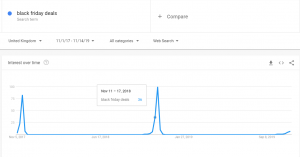
Google Trends: shoppers are becoming accustomed to searching for Black Friday Deals as early as two weeks prior the event, offering early deals can offer a competitive advantage in terms of CPCs.Sale Cycle: Sales Patterns Around Black Friday. Data on sales volumes last November shows the effect that Black Friday has on ecommerce sales. Sales are consistent throughout the month, before increasing in the few days before Black Friday. (The data comes from clients in both the US and UK).
Integrate messaging: In a world of omnichannel commerce, it has never been more important to ensure consistent messaging across all platforms. It’s important to a have a feedback loop in place where data from ecommerce activity is feeding creative in real-time to ensure media spend is being maximised.
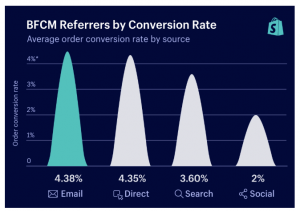
Black Friday conversions by channel. Stats from Shopify show the best performing channels in terms of conversion rates over Black Friday weekend 2018.
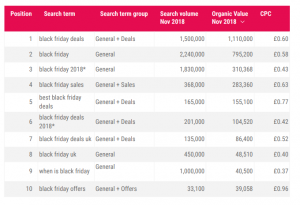
The long tail: With cost per clicks skyrocketing for key terms particularly around clothing, tech, toys and smart home, make sure to have the best organic exposure possible and build this in the months prior to Black Friday via link building, content syndication, keyword matching and organic reviews.
PI Data Metric Report. Individual search terms: sorted by organic value | November 2018. Plan your content around the most valuable generic terms.
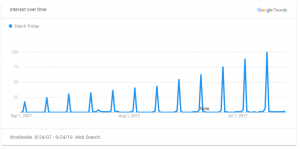
Google Trends: over the last 12 years, search volumes for ‘Black Friday’ have steadily increased. Typically, search volumes begin to build mid-September, peaking in November. According to Google, Back Friday searches have increased by 80% over the last two years.
Retargeting strategies: History has shown us that typically customers over the Black Friday period are not the most loyal – they are heavily influenced by price. However, it’s important to retarget your existing customer base with your specific deals, guides and personalised promotions to cut through the ‘noise’.
So, the goal posts maybe changing, but Black Friday continues to be a make or break time for UK retailers, particularly when there are so many uncertain macro-economic factors at play. The key to it being a success is to plan early, personalise, integrate messaging and above all else, have the right products ready for your audience!
By Neilson Hall, Head of Ecommerce UK, OMG Commerce
My role as Managing Director at Benchmarketing continues to evolve to reflect the changes within our industry and the needs of our clients and OMG UK agencies. As managing director, my role is to manage a team who run consultancy projects and curate datasets to provide insights, benchmarks and case studies across client categories.
As a mathematics graduate, I always knew I wanted to work with numbers and data, and the work at Benchmarketing definitely requires a high degree of numeracy! I am hands on (maybe too hands on) with every project run.
Omnicom Media Group UK is flexible in terms of its working practices. If I have a lot of presentation creation work on, I will usually work from home so I can get my head down and really focus on the task at hand, get some peace and quiet and good thinking time. We have a number of tech solutions across the group, allowing me to work remotely.
Start of the week
Like any managing director, I have several hats to my role. Firstly, there’s the day to day servicing our clients, running through pieces of analyses, answering requests for work and working with different teams and partners both within and outside of OMG UK. Secondly, there’s managing the team who do the work. Finally, the longer-term view of running and improving the business; at the moment I am very focused on 2020 planning, which includes resource management, prospecting and partner relationships, but also coming up with new ideas, extending our remit, and always involving numbers.
Typically, on Monday I work from home, then on Tuesday I have a busy day running through the schedule for the week. We hold a weekly team catch up to check on projects running to time, and the other data aggregation tasks that need to be done, plus assigning new tasks that have come up.
Mid-week
The middle of the week is where we usually meet with our agency contacts, clients and media owner clients either at Bankside, client offices or the Crescent, where two of our media agencies (OMD UK and PHD) are located. Planning these meetings to avoid several cab journeys a day is an art! I try to do Crescent meetings at the beginning or end of a day as it’s easy for me to get home from there by public transport.
Usually mid-week is also a good time for us to deep dive into our projects. Even though we are a small team, we usually have three or four big projects on the go at any one time. Each paid project involves dataset creation, both routine and new analysis, results visualisation and creating digestible insights for agencies and clients, with typically me and a lead then support analyst on every project. With only six people in the team that means multitasking is a must.
We are currently working on a new project inspired by OMD UK’s Create Team, looking at setting benchmarks on how to use influencers within media and marketing. Surprisingly, this is an area that hasn’t been explored in too much detail, so it is really exciting to create a new industry standard, if we can do that – there seems to be a big lack of evidence! We’re publishing a white paper on Influencer Marketing in early November.
We work very closely with all four media agencies and some Specialist Services within the OMG UK sphere, so I try to spend as much time as I can working directly with the senior leadership of these, with my junior team running clinics and discussions at agencies a couple of times a month.
Friday
Friday is a day I have to myself, as I work four days a week. I leave London and head to my Cotswold house with garden and two ex-feral cats Margaret and Phillip. After my normal chores, I usually try and switch off and busy myself with seasonal tasks, such as gardening or cooking. At the moment, I am making a whole batch of different jams from produce from my Cotswold garden, as well as planning Christmas events at my Pembrokeshire B+B. It’s been fascinating setting up a business with staff, insurance issues, managing a payroll, and forecasting future revenues – has given me a lot of respect for OMG UK “back office” teams.
Even though I am not officially working, I keep an eye on my emails and may dip into a project if there is a significant issue or something is extremely time sensitive.
What advice you’d give to someone starting their career?
You have two ears and one mouth – use them in that proportion. Especially when you’re new, it is very important to listen and learn from people and take in as much as possible. Also, please really embrace work, if you want to progress you need to invest in us, work hard and deliver, we will then invest in you.
By Sally Dickerson, Managing Director, Benchmarketing
Throughout my career I’ve enjoyed finding new ways to communicate the stories of some of the world’s leading entertainment and consumer brands from launching PlayStation3 to kicking a record company’s prized back catalogue into the digital era or creating brand and technology partnerships to make a cable company synonymous with entertainment, not utility. The interesting stuff has always sat at the intersection of entertainment, media and advertising, and my role at DRUM is no different.
There is no typical week at DRUM, but, as the leader of a creative business, there are four constants that are pervasive from week to week and month to month, and typically where I try and find a balance in how I spend my time every day. Creative, clients, commercials and culture – from what we do to who we do it for, how it pays back and most importantly, what we stand for and how we empower our people – it’s a constantly changing dynamic and it’s what gets me out of bed in the morning each day.
Let’s explore this in more detail.
Creativity
DRUM is not a traditional creative agency. There is a huge scope to our work from creating global social campaigns for the likes of Kingfisher and Jura Whisky to showstopping Christmas campaigns for major retailers, in addition to brand strategy and media partnerships.
Creativity that earns attention is the common thread that runs through all our work, but the one thing we particularly focus on is creating work that drives long term effectiveness for clients. Our role is to seek out non-traditional solutions by leveraging culture to help brands connect with their audiences in a real, relevant and authentic way.
You see far too many brands trying to shoehorn themselves into pop culture or jump on the back of cultural movements that just don’t fit in with the brand, ultimately producing campaigns that lack authenticity and relevancy to the audience.
Clients
For any agency, clients are the life blood of the business. I like to be hands on with our clients, working directly with our fabulous client teams to ensure that not only are we producing best in class work, but also anticipating any future needs before they arise.
The key to client relationships is trust. As an agency, at times it is important to challenge your clients and push them into being brave and bold. However, this only comes from a place of trust – something that is earned and can never be taken for granted. Building that trust takes time.
From my experiences working client side, I always wanted an agency to work with me as a partner rather than a supplier, and this is what we strive to do at DRUM on a daily basis; be partners and consultants for our clients.
This year has been a big year of pitching and pitch wins. You learn so much through a pitch process and I think it’s important as an agency head to lead from the front. I love solving challenges for brands and highlighting how DRUM is uniquely positioned to do so. Pitches are something that gets the heart pumping slightly faster.
Commercial
Over the past year, we have been very successful in building new client relationships and welcoming some world class brands across a variety of sectors to DRUM. I’ve personally spent a lot of time thinking how to unlock growth and also to make sure that as we welcome new clients to DRUM they get the attention, care and focus they need so we can help them get to brilliant, disruptive creative solutions quickly after onboarding.
We’ve also been rolling out DRUM across other markets over the last 18 months or so, and now have a growing network of offices in six markets – from Copenhagen to Auckland, New Zealand – and have further expansion planned over the coming months/year with a keen focus on APAC and China.
Culture
Culture at an agency is hugely important, and I am a big believer in that culture comes from the top as well as the bottom. The culture of an agency or any workplace is vital to the health of the business. You can have the most talented people in the world working at a business, but if the culture isn’t very good, the work will suffer.
Therefore, it is essential to build a culture that people want to be part of and thrive in. I am a huge believer of agile working, but there still needs to be a central core that people identify to. At the top it is about being receptive to the challenges the agency is facing, reminding people that the pressure they are feeling at a significant time won’t last forever.
What advice you’d give to someone starting their career in media?
Be open-minded, be bold and be clear – make your career work for you.
I am a media planner at OMG UK, focusing on multicultural marketing.
After graduating university with a degree in maths, I wanted to learn how businesses work and grow. My first job was in business development, which is at the forefront of business expansion and attracting new clients, so it was a great introduction and real-life exposure into how business really do run.
From there, I joined Omnicom Media Group’s investment team, working on the analytical side of the business and the numbers behind it – using my maths degree. While I was there, I found out about the multicultural marketing arm of OMG UK and knew that is where my passions lay. It took me a whole year to get the job, but here I am, and I love it.
Multicultural marketing is dedicated to understanding multicultural audiences and communities and translating this understanding into media plans. It’s a very human take on data.
Monday
I start my week by going through all the emails received over the weekend and creating a to do list. Tasks that have deadlines coming up get priority, but I aim to reply promptly to all messages and make sure everything is under control as we start a new week.
Most of Monday is spent setting up for the week, coordinating with teams I work with and chasing anything that’s pending from the week before. Of course, I also get started with media plans and content that needs to be done that week.
Tuesday
If there are no emergencies or unforeseen issues, it’s business as usual.
What I really love about my job is that no brief looks the same and no brief has the exact same target audience. This means the research I do varies enormously every time – one day I may be looking into Polish Christmas and the next day studying tropical diseases.
I pray every day at lunch time (we have a prayer room in the building), and on Tuesdays and Thursdays I make time for a run during lunch hour. A leisurely jog along Thames does wonders to your wellbeing. If anyone wants to join me – send me an email!
Wednesday
This is a day for meeting client teams and talking to media owners to make sure everything is on track and everyone’s happy.
It’s also a day when I like to put some time aside for my extra-curricular apprenticeship; I’m spending approximately one day a week learning Python and SQL in order to be able analyse data more efficiently.
Thursday
Towards the end of the week the focus tends to move on to reporting. This means either putting together research reports, or if not responding to briefs, doing post-campaign analysis. Learning about multicultural audiences and communities is an aspect of the job I truly love, and it’s great to see our learnings reflected in the reports. This really makes you understand the power of data. All the recommendations we offer our clients and other teams within OMG UK are fully backed by data.
Friday
Last day of the working week is all about tying up loose ends: responding to emails, finalising documents and projects, and making sure campaigns are running smoothly as we head into the weekend. For me, weekends often start with a sober event, such as meeting friends at a night café over hot beverages and a good DJ.
What advice you’d give to someone starting their career in media?
Lift other people as you rise. It is something I live by. I consider it a social responsibility to support others on their journey and leverage the privileges I have in order to help them get further.
What’s the best advice you’ve ever received?
It came from my sister, who reminded that every time you leave a job, make sure people miss you, as that way there is always a door open for you.
Swapping the sun and beaches of Sydney for London is a trade that most people would say “How about the other way around?”. For me, it was something I always wanted to do.
As head of design at Omnicom Media Group UK, my role is hugely varied, which is something I love. As lead designer, I am working on a range of things each week. However, one of my favourite aspects in this role is being a brand ambassador – I am often asked to review documents, approve deliverables or provide advice to ensure our visual design is “on brand”.
I have always had a passion for design, but what anyone who I work with will tell you is that I have an even bigger passion for the process behind it.
Monday
Even though my working week is always varied in terms of projects day-to-day, my Monday always starts the same way – the weekly ‘Design Scrum’.
The weekly Design Scrum is an opportunity for the central design team to sit down and discuss the week ahead. We plan how to best utilise our resources, set the priority for design projects against deadlines and analyse how many requests we have received from specific agencies/Specialist Services. These requests range from events collateral, pitch communications, key stakeholder presentation decks, concept designs for a new brand, new starter brochures…and everything else in between.
As well as planning the week ahead, it is also a chance to go through feedback from projects delivered in the prior week to identify key learnings or better understand what worked well. It is also a time to chat about any new updates that may have gone live on Adobe’s design applications or new features that may help to improve our workflow and design efficiency.
After the Design Scrum, I will catch up on new requests (you would be surprised as to how quickly our inboxes fill up on a Monday morning), especially for creative projects that involve art direction or to create website concepts, for example.
Tuesday
Tuesday is the day I have scheduled to check in with the designers across the group – getting an update on live projects, design workload and whether additional support is needed, especially if there is a pitch coming up.
If there is a pitch that week, depending on the deadline, I usually help manage the design process (told you I love a process!). This may involve making sure resources are allocated against the workflow planner, helping orientate and on-board freelancers with brand guidelines and project objectives, or providing creative direction to designers. I also enjoy rolling up my sleeves and lending a hand to any design that needs doing to ensure we meet deadlines.
Wednesday
This is usually my day working from within one of the agencies in the group. It is an opportunity for the designers to ask questions about the work we are doing centrally, for me to provide mentoring and guidance, or perhaps adopt a more hands-on approach with design. It’s also a great time to run through the developments of any new software or suppliers that we are planning to work with.
Apart from process, one of my passions within this role is helping to mentor and enhance the design skills of those in my wider team. This may be imparting some technical knowledge or sharing wisdom on managing people and processes. Or, sometimes, people just want to have a chat about things outside of work – I always try to make time for a coffee to check in and see if everyone is OK.
Thursday
Thursday is reserved for the more business-focused side of my role. It is a time to review our design strategy and business objectives, in addition to working through the reports, financials and budget planning for the design function. I also try to use Thursdays to build our external supplier relationships by meeting with account managers to discuss any new innovations they may have that could be beneficial to the group and agencies – whether it is negotiating new prices or services, reviewing software and tools, or considering new technologies for the business.
Thursdays are also a day where I spend quite a bit of time working with the central PR and Marketing team regarding design direction and support for external content. We have a lot of content that goes out on a Thursday, so, with my brand ambassador hat on and design eye, I approve the final assets before we click ‘publish’.
Friday
As a team, we try to keep our Fridays relatively free in order to give us time to work on any last minute or ad hoc design requests – especially if Specialist Services have been asked to speak at an event or invited to a pitch. We also use Friday afternoons to update and work on longer-lead projects, such as the redesign of internal documents or presentations.
Where possible, I try to end the week enjoying some social time with the team, before finally logging off and recharging over the weekend for the next week to come.
What’s the best advice you’ve been given?
Promise what you can deliver, deliver what you promise.
I could never be in a job that didn’t allow me to interact with people inside and outside of my company.
My first real taste of marketing was at university, where I joined Red Bull as an ‘energiser’ / brand ambassador. It gave me an amazing insight to how people interact with brands and allowed me to meet loads of cool people along the way (yes, I did get to drive a Beetle with the Red Bull can on top).
I started my career in experiential marketing where I spent five years servicing clients ranging from FMCG brands to tech. I joined Omnicom Media Group UK in 2013, working in the central new business and marketing team across various functions including marketing, new business and events. I now head up the events side of the marketing team and am responsible for curating and running all OMG UK events. It is a hugely varied role which encompasses everything from small workshop sessions to bespoke client dinners, to the Christmas party.
For me there is no typical week, which is something that I love about my job but also presents a number of challenges, especially as working flexibly means that you have to be super organised and understand what to prioritise.
Monday:
OMG UK is hugely flexible and supportive to parents – I don’t work on Mondays, so my day is spent trying to control my four-year-old and two-year-old children, which can be just as if not even more stressful than when I am in the office!
Tuesdays:
Tuesday is all about meetings. As it is my first day in the office – I have several catch ups with my team regarding events that are in the pipeline as well as catching up with venues, chasing RSVPs, drawing up seating plans, for the next event.
It is also a chance for me to sit down with the OMG UK agencies, Specialist Services and their teams to run them through the status of events, requirements, as well as supporting on curating the content and making sure that the right people are invited.
Wednesday:
Typically, the events we run fall on a Wednesday or Thursday, so these can be two of the busiest days for me and my team. If there is a conference style event happening that week it will be an early start.
I try to get to the venue for a major event at least an hour and a half before the guests arrive to make sure that everything is set up and the tech is up and running. Occasionally I am running around putting out fires (figuratively not literally). Once the guests arrive, it is about making sure that everything is running smoothly, and everyone keeps to time. It is amazing how quickly things can go off script if someone runs over….
If we are not running an event on a Wednesday, we are certainly planning for one. So, my day is usually taken up by site visits, dealing with suppliers, nailing down speakers and crafting invitations with the design team.
Site visits are a hugely important part of the role, as we are always looking for different venues and spaces to hold our events. Earlier this year we held a client dinner on top of Tower Bridge which was amazing but topping that is going to be difficult!
Thursday:
Thursdays are all about feedback. We spend a lot of time after an event ensuring that we capture and collate feedback from everyone that attended, as well as the speakers. We ask for feedback on a number of different areas such as rating the venue, length of session, favourite topic and speaker as well as the catering.
These feedback forms and reporting back are essential, as everyone knows that running the same event repeatedly can become stale, for both the speakers and the audience.
It is also a day for tying up any loose ends and briefing the team for any eventuality that may hit our inboxes.
There is also frequently some sort of social event going on in the evening, so I will be ensuring that everything is prepped for that and making sure that the budget for drinks stretches past 9pm.
Friday:
Its back to spending time with my children and enjoying the weekend before it all starts again the following Tuesday.
What advice would you give to someone starting a career in the industry?
Don’t be afraid to ask for help. There is no such thing as a stupid question. Also be positive – positivity is infectious and will rub off on your team and colleagues.
By Sarah Colby, Head of Marketing & Events, OMG UK
I’m Aya and I work in the People Team at OMG UK. I look after Learning & Development for OMG UK and Graduate Recruitment across all the agencies.
Before starting at OMG UK, I graduated with a master’s degree in organisational psychology and worked at Goldman Sachs as a graduate recruiter. It was a great experience and I learnt a lot, but I wanted to be in an environment where I could make an impact.
I knew from my first interview that OMG UK was where I wanted to be!
I had no experience in media and knew very little (does uploading pics on Instagram and snapchat count?) but was willing to learn and wanted a new industry where I could build upon both my skills and knowledge. I quickly came to realise OMG UK is somewhere where passion and attitude come first.
Monday
I usually get to my desk around 09:20 and get a pain au chocolate from the canteen – I can’t get enough of our free brekkie! I’ll grab a green tea and head back to my desk and start by planning my day and checking my to do list to see if there are any actionable items from the previous week. I’ll go through my inbox and decide what needs to be prioritised.
I cover both Graduate Recruitment and L&D, so my routine varies day by day. I’ll check all details are correct for the interviews scheduled in for the day and reconfirm any interviews for the following day. I’ll then sift through graduate applications received over the weekend and set up screening calls with any potential candidates.
Once it hits lunchtime, I take a stroll outside if the weather is nice or go up to the canteen. I like to watch a Netflix episode during my lunch hour!
After lunch I put aside the grad recruitment and work on L&D. I’m currently working on different projects, such as setting up mental health awareness days, creating guidelines and working on training needs across the agencies. I like to leave on time to catch my train back to Surrey – so my day typically ends at 5:30pm
Tuesday
I tend to spend the mornings carrying on with any current L&D projects. I may have meetings in the diary with Facebook or Google on training programmes we can incorporate within the group. I love being able to work on diverse projects across the different agencies under OMG UK – I get to spend time talking to and engaging with such insightful people.
I also have a catch up with my line manager on Tuesdays. We go through all the things we are currently working on or have in the pipeline and discuss graduate recruitment. It’s great to talk it through and see what we can do better, what needs focus and what can be put on a back burner. My manager is extremely supportive, and I think this is one of the most important aspects of any role: to have a relationship in which you can ask for help or some guidance!
I spend the afternoon on candidate screening calls, really trying to gauge what drew them to the media space. This is more of an informal format; in which I can recommend any roles I think would align with the candidate’s skills. Once they’ve confirmed interest, I will go through our recruitment portal and inform the hiring manager that the candidate is ready to be reviewed.
It’s a great buzz talking to young, passionate talent, and I am always learning on the job and developing my skills as I work across different levels of seniority in hiring managers.
Wednesday
On Wednesdays I tend to focus more on graduate recruitment. This is usually the day I have back to back candidate calls scheduled in, as I usually have anywhere between 15-20 graduate roles open at any given time. I also have a couple of apprenticeship roles across the group, so it’s a great day to put aside and focus on grads, apprentices and data fellowships.
This is where I usually have a catch-up call with our partner vendors to see if we have received any feedback and how we can continue to ensure a smooth process, so that everyone is making the most out of their apprenticeship and fellowships, and what support we can give.
It is usually mid-week that hiring managers will have reviewed candidates put forward to roles on Monday/Tuesday and let me know if they’d like interviews scheduled in. I schedule these interviews in for the end of the week, follow up on any feedback given for past interviews and set up second stages. It’s a lot of candidates at different points of the process so I like to keep a lovely spreadsheet to stay on top of everything (I love a good spreadsheet!).
Thursday
I start the morning sifting through any applications received during the week and set up a couple of calls for the following week.
My focus on a Thursdays is on L&D projects, ensuring everything is set in terms of logistics and bookings. There are times when we need to promote training days, so I work with New Business and Marketing team to get fliers or design assets to send around to the group. If a training day has taken place, I’ll create a feedback survey and have this sent to gather feedback. This gives us data whereby we can see what we need to keep or change for the next time we run a training.
Friday
Friday tends to be the quietest day of the week. I use this day to go through my to do list, ensure everything I wanted to action for the week has been done, and sort through my inbox. I use my inbox as my own personal to do list, and I am an avid organiser, so I have a few different folders for different projects. Organisation is key when working a role that has two very different sides.
What is the best piece of advice you have received?
My old manager at Goldman used to have a motto: ‘Will someone die if this is left until tomorrow?’ ha!
But really, that’s the best piece of advice I’ve been given in the working world. It’s very easy to get caught up and lose out on a work life balance, or to stay that additional hour or two, and before you know it, it’s 9pm (anyone who’s been in corporate will understand this!).
It’s always good to ask yourself: ‘if I didn’t do this piece of work now, would this have a detrimental effect?’ This puts a lot of things in perspective. If the email isn’t going to have a knock-on effect, it doesn’t need a response in the evening when you are switching off – leave it until tomorrow. It’s about being smart with your time.
Who has been the biggest inspiration in your career?
The biggest inspiration in my career has been the Head of Recruitment when I worked in the Recruitment team at OMG UK. I am very blessed to have worked with one of the best female leaders (and I am even confident in saying the best I will ever see!). Watching her has taught me the importance of spending time and effort in getting to know your team, understanding what each person’s working style is, identifying everyone’s strengths and leveraging them, but also paying attention to areas of improvement and working together to tackle issues. I think it’s very rare to find a leader who has time for absolutely everyone, is always positive and recognises that there are good and bad days. She has taught me that it does not matter if you make mistakes, in the working world or outside, the most important thing is to recognise it, own it and find a solution for it. This is advice that should be given to anyone. If I’ll become half the woman she is (cheesy) in the future, I’ll feel extremely accomplished.
By Aya Alsahaf, Learning & Development Executive, Graduate Recruitment, OMG UK
This article was originally published by The Drum.
From our first day in this world, we are who we spend time with. For most of us, these people will be from a similar background and have a similar skin colour. Therefore, we’re inherently racist –something we’re all aware of, particularly in the current norm for unconscious bias training and other initiatives. While I’m a true believer in their effectiveness at work, we as experts of consumers must truly understand what it takes to create diverse and inclusive environments.
Where we have made strides in the workplace is bringing initiatives, such as unconscious bias training, running alongside internal and external D&I training. More and more businesses are creating internal D&I groups to educate and engage employees, as well as introducing programmes or special units to help ensure all our client work is inclusive.
Agencies have also started making strides to ensure that bias is removed from recruitment process to ensure the best talent regardless of background is hired.
However, these practices are all work related. How can we change a habit of a lifetime, engraved into our cognitive thinking from day one?
Firstly, we need to change our fundamental way of living, seeing the world and others in it – we really need to “experience” the lives of those different to us. The learnings at work need to be applied to our lives; the very siloed environments that have created the issue need to become inclusive to change a habit of a lifetime.
Most of us are part of, or living with, a generation that have been taught, either consciously or unconsciously, to believe that having white skin is superior. Whether it’s the non-existence of non-white people to look up to in the media, or that white dolls are assumed to be ‘the most beautiful’, or depictions of terrorists based only on religion or culture, our realities and understanding of self are constructed on those bases. But don’t just take my word for it: this has been proven through a series of tests, such as The Doll Test and ‘The female fair and unfair play partner’ featured on BBC’s Babies: their Wonderful World -documentary.
If young children whose cognitive processes are still developing have already started building their bias, what does it mean for adults who have been subjected to these ideas for most of their lives?
Perhaps an answer lies in the way millennials see diversity. Unlike baby boomers or Gen X who view diversity as a set of checkboxes, eg race, equality, disability, gender, millennials see diversity and inclusion as experiences that go beyond all of that.
They see diversity as different backgrounds, experiences and perspectives – they understand that the colour of skin doesn’t (have to) define us, that we are the product of our roots and our class. After all, there is such thing as class, which can go well before the colour of your skin, and skin folks are not always your kinfolks. We could be born into certain ethnicity but have grown up in an environment where none of them stick together or get along. In other words, it’s the cognitive diversity millennials want to see.
Diversity and inclusion issues can only be solved if all us can truly understand how the other half lives. If you’re one of those who thinks that an unconscious bias training and a few diversity and inclusion panels will change decades of influence and bias, or that they put you in a position to make D&I decisions on behalf of others, you’re just delusional.
As mentioned, what we’ve started doing is great, but real change isn’t achieved with just a few training sessions and events– it is achieved when you implement changes to your life and the environment which created the issue in the first place. Those in the majority need to be allies to those in the minority: not just at work but outside of work too. A true ally is part of a person’s life and understands them deep down. This, of course, works both ways. We need to look beyond the checkboxes to understand who people really are if we want to re-educate ourselves.
To embrace diversity and inclusion, we all need to be part of diverse and inclusive communities and friendship groups. We need to give a voice to those whose voices have been supressed, while understanding why those from privileged background act the way they do. This needs to work in conjunction with each; minorities to majorities, majorities to minorities, but whoever we are talking about needs to lead that conversation with the support of allies – by passing the mic we need to all be supporting the conversation.
I started my media career in 2008 working for a small boutique agency where I learnt the ropes of digital marketing, ecommerce and communications planning before joining the Omnicom family in 2011. I spent three years honing my planning skills across on a range of FMCG, retail and entertainment businesses.
My passion for digital marketing and data took me on a path to join Omnicom’s Programmatic specialist team in 2014, starting as an Activation Director looking after a small team. The team, our programmatic capabilities, and my own career have had exponential growth since then. Five years on, I am now Head of Activation and responsible for Omnicom Media Group UK’s programmatic activation across all channels (display, mobile, video, audio and emerging programmatic channels). My role is to support the programmatic teams across the agencies, advise on best practice and educate on how to effectively buy programmatically and use different technologies to deliver marketing objectives.
Monday
Working across a large team that spans across four agencies, I use the start of the week to communicate important updates and information. This includes updating our leadership team of latest strategic business development, team management, performance and activation test results, and separately hosting status meetings for the agency teams to facilitate knowledge sharing and talk about the latest technology changes. The beauty of working in the programmatic team is that the industry is constantly changing, evolving and innovating – so there is always lots to keep up to date with.
Tuesday
No day is really a typical day. As the new week begins, there will be opportunities to work on a diverse range of subjects, including tools for understanding audiences and online behaviour, analysing data to devise a strategy for optimising a campaign against a goal, evaluating new opportunities with technology, working with publishers to assess the best and most efficient route to their inventory, or working to support the other central operation teams to deliver successful projects.
Wednesday
Part of my role is to work closely with market leading ad tech companies to develop Omnicom’s programmatic offering and expertise. I spend time alongside our Head of Technology and Operations Directors to feed into product development, feature requests and help communicate the needs of our clients to the technology owners.
At our Bankside office, we have a lovely rooftop terrace and canteen, which is a great place to have lunch. I aim to spend at least two days a week having lunch with people across the team to take a step back, share and catch up on life outside of media. People who work in media and advertising tend to be very passionate about the industry, so often the conversation will turn back towards the latest media news.
Thursday
In digital media, there is always ongoing testing for new formats, publishers, vendors, and features of Demand Side Platforms. Part of testing is to ensure there are clear hypotheses and frameworks to work within, which I help create. Another part of testing is troubleshooting to find solutions for operations, which is like trying to solve a puzzle using lots of different elements.
Part of the fun working in the media industry is the social nature of the people. We often go out to various restaurants, bars and sporting events as a team, and Thursday tends to be the night for that!
Friday
Working with a range of different technology partners, it is part of my responsibility to ensure talent in the team is nurtured and developed. In the mornings, as the day tends to be a bit quieter for ad hoc requests, we use this time to host training for the team with technology vendors or publishers. As we head into the weekend, the activation team will be finalising new set ups and ensuring campaigns are on track for pacing and performance.
Who has been the biggest inspiration in your career?
Where I started my career, they taught me that I had the potential to do anything if I put the work in and pushed through boundaries. Now, I am inspired almost every day by the stories I hear and the people I meet.
What advice would you give to someone starting a career in the industry?
Question things, take an interest, form an opinion, and never shy away from the opportunity to learn something new.
By Melinda Clow, Head of Programmatic Activation, OMG UK Programmatic